Saturday, November 19, 2016

Yaddo

Yaddo Mansion
September 29, 2016

A History of Yaddo
The property on which Yaddo stands originally housed a farm, grist-mill, and tavern operated by Jacobus Barhyte, a Revolutionary War veteran who fought at the Battle of Saratoga. Many well-known writers of the 1830s and 1840s dined at Barhyte’s tavern, among them Edgar Allan Poe.

In 1881, Spencer Trask, a New York City financier, and his poet wife, Katrina, bought the property, naming it “Yaddo” at the suggestion of their young daughter. When the main residence burned to the ground 10 years later, the Trasks built the present mansion, completed in 1893. It was the scene of famous house parties attended by artists, statesmen, and industrialists.

Spencer designed the Yaddo Gardens in 1899 as a gift of love to his wife Katrina. The Trasks based their design for the Rose Garden on Italian classical gardens, which they had seen on trips abroad. The adjoining Rock Garden expresses in contrast an Anglo-American tradition of interest in indigenous landscape. Together, the gardens combine the formal and the free, the poetic and the idyllic, human art and nature. Katrina wanted her garden to be a garden of delight, a garden of romance, as an expression of her own life.

Engraved at the center of the arch on the gate are the initials ST KT for Spencer and Katrina Trask.
January 28, 2016

The future of this great estate was determined after the deaths of their four children left the Trasks without heirs. In 1900, they secretly formed what would become known after their deaths as The Corporation of Yaddo and they endowed it in perpetuity to administer a working community of artists. Noted philanthropist George Foster Peabody, a lifelong friend of the family and husband to Katrina Trask in the last year of her life, put their plan into operation after Spencer Trask died in 1909 and Katrina Trask in 1922.

National Historic Landmark

January 28, 2016
I discovered the entrance on accident, exploring the back roads of Saratoga Springs after an orthodontist appointment. As I was getting ready to jump on the Northway to go back home, I saw the front gate entrance proudly bearing the name Yaddo.

I remembered the name Yaddo from a conversation I'd had with a girl that grew up in Saratoga Springs.

I don’t know what I was expecting…
I also wasn’t let down.

I feel like the first time I walked around the gardens was the most magical.
Perhaps it was because everything was so new.
Hidden gems on the grounds still waiting to be found.
Perhaps it was because it was the only time I ever visited Yaddo where I was completely alone.
Apparently, over 50,000 people visit the gardens each year!

I get a good laugh about me going to a rose garden in the winter, but in all honesty, it was exactly what I wanted.

refreshing aloneness!
the crisp winter air
stabbing at my lungs
I breathe
slowing down time
my body feels
a magical and vibrant energy
radiating
from the frozen ground
reminding me to
just be

Frozen Rock fountain at the upper level of the Rock Garden.

View from the Rose Garden of the Balcony where the Sundial rests, and the Pergola.

Under the Pergola.

May 26, 2016
I thought it would be a good time to revisit the Gardens at Yaddo because surely there would be flowers, the statues would be uncovered, and the fountains would be flowing. To my surprise, that wasn't the case.

Of course some things were different.
The statues had been uncovered, but only one fountain was flowing.
and there weren't any roses…


It was a warm and sunny day
I was trying to determine whether or not the sundial showed the correct time.
When...
a stranger asked me,
"Have you ever hugged a tree?"
the words hung in the air
full of doubt
(why would this question come up amongst strangers?)
"Actually, I have." I said matter-of-factly with a smile.
The same smile that drew her to me initially.

She had mentioned my smile when she first approached me.
I can't seem to forget this exchange with a stranger.
It makes me wonder how others perceive me.
And I also wonder why it is that strangers always talk to me...

perhaps it is my smile

Foot of the Sundial.

Trillium could be seen throughout the Rock Garden.

The Wood Nymph Statue in the center of the pond in the lower level of the Rock Garden.

September 29, 2016
I felt like I should see what the Gardens at Yaddo looked like, one more time before winter approached. Maybe this time there would be roses...

The whole garden was in bloom!

Standing in the Rose Garden.


Roses blooming all along the Pergola.

View looking out over the Rose Garden from the Balcony.
The "Four Seasons" Statues can be seen bordering the far side of the garden.

The Gardens at Yaddo
The Rose garden is laid out on a north-south east-west axis. It is divided into four beds centered by a fountain and overlooked the three terraces, a balcony, and a rose-covered terra cotta columned pergola. Red, pink, white, and yellow hybrid tea roses and floribundas planted together reflect Katrina’s color scheme. In 1994, standard roses were introduced. Polyantha roses were planted at the base of the standard roses to simulate the early planting of dwarf roses.

View looking out over the Rose Garden from the Balcony.
All the statues are covered for the winter season.
January 28, 2016

Fountain in the center of the Rose Garden.
I was distracted for a while at this fountain.
Communicating with the dead.
My father and my Grandma Alice in the same garden.
So comfortable, so serene.
September 29, 2016

The sundial on the balcony is inscribed with a message from the Trasks’ friend, the poet Henry Jackson van Dyke:
Hours fly, Flowers die, New days, New ways pass by, Love stays.
Time
is
Too slow for those who wait
Too swift for those who fear
Too long for those who grieve
Too short for those who rejoice
But for those who Love Time is
Eternity


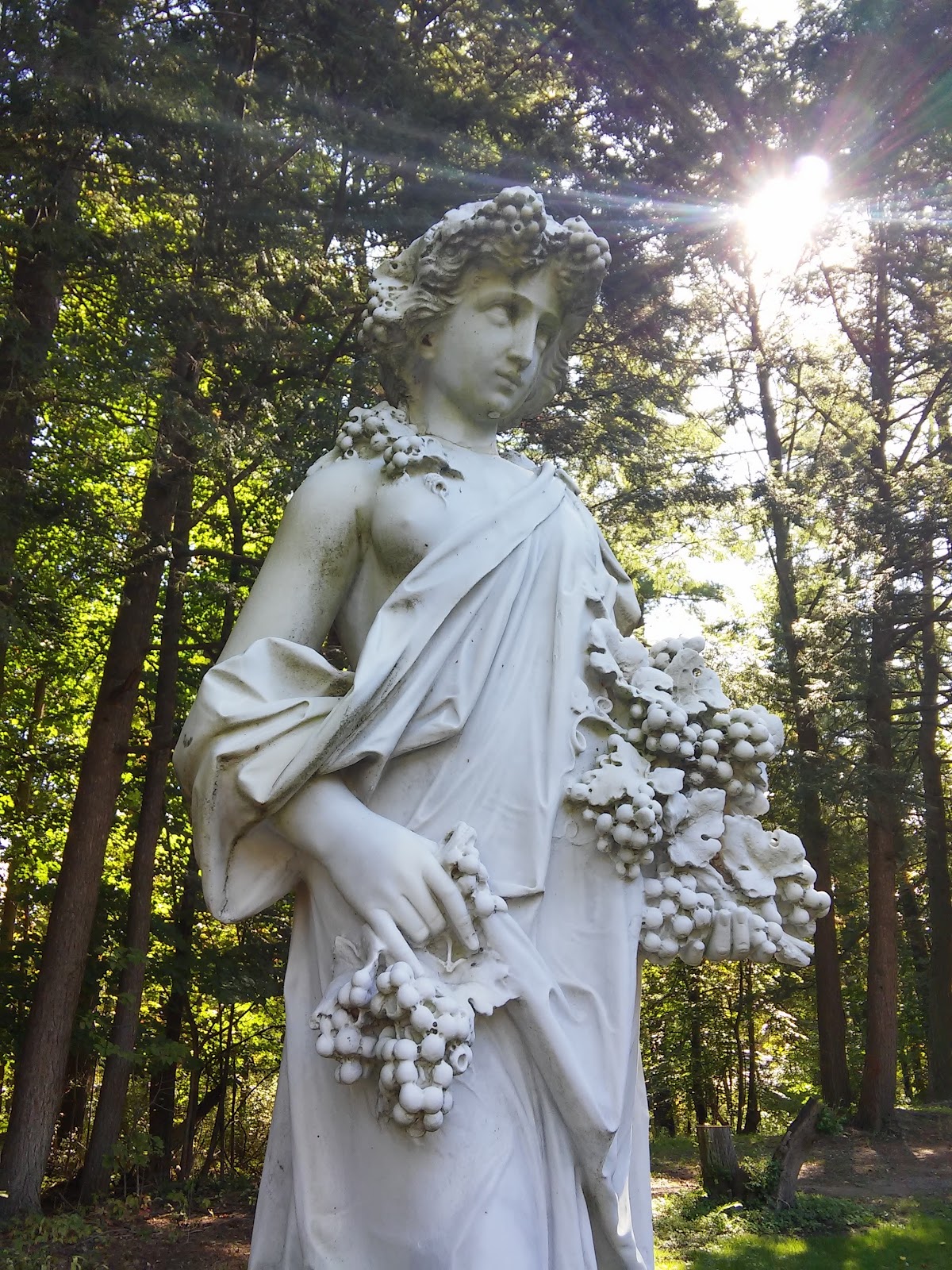
East of the rose beds are Italian marble statues of the four seasons and a statue of a youth, “Christalan,” sculpted in marble by William Ordway Partridge in 1900 as a “memorial to the children of this house.” Christalan represents youth, chivalry, and victory over mortality.

Spring

Autumn

Winter

Summer

Christalan Statue

The renewal of the Rock Garden, west of the pergola, emphasizes the original design features of an upper and lower pond with fountains and a long connecting rill of flowing water bordered by dolomite rocks with a separating rocky incline. All are planted with spring and summer flowering perennial plants. As much of the original plant material as made possible by the shading of mature trees has been incorporated. The effect is as close as possible to the 1905 garden given the different light conditions. The lower pond area is highlighted by restoration of the “riot of color” of the flowering plants growing there.

Rock fountain in the upper section of the Rock Garden.
September 29, 2016

Wood Nymph Statue in the lower pond of the Rock Garden.
September 29, 2016
Yaddo’s Mission - to provide artists uninterrupted time to work, good working conditions, and supportive community - has remained central to its operation throughout the years.

All photos were taken by me.
For more information about Yaddo... Click Here!
I got my information about Yaddo from the brochure available at the gardens.

Wednesday, November 2, 2016

Tallulah Spring at Saratoga Spa State Park


Tallulah,
the forgotten "leaping water"
tucked away,
just slightly out of view,
from those who pass her by.
I had searched for her a few times.
I had walked past her numerous times.
never knowing
she was patiently
waiting...
on the hillside for me to find her.

On some Saratoga Spa State Park maps there is a spring simply listed as #5.
I had poked around the general area of where the spring was marked on the map,
but I never actually found it...
One time I was searching for #5
and I stumbled upon Ferndell Spring
which was delightful and delicious!
... but not the spring I was hunting.

October 2, 2016- I was tasting different springs throughout the park with my friend Becky, when I saw #5 spring for the first time. I was ecstatic upon the discovery and so very impressed with the spring's color, as well as the uniqueness of her erosion tendencies, all while creating a calcium carbonate alluvial fan, slowly over time.


I found the colors to be an eye-catching intrigue. The contrast of the green grass against the red soil was perfection, as the grass tried its best to strangle a narrow crevice created by the run off from the spring.

Tallulah Spring carving the landscape narrowly,
with tufa collecting far below from her steady stream of water.

The tufa and green algae growing in the farthest run off from the spring were intriguing as well. I imagine the rusty red slicing its way through the tufa are iron deposits, but I don't really know for certain. Something I found odd yet fascinating, was how Tallulah's water and mineral deposits just ran into the tall grass surrounding her, leaving no clue to people on the other side of the tall grass that she was there at all.

Tufa from Tallulah Spring.

After spending some time at this spring and enjoying her unique beauty, I obviously had to do more research about this elusive spring.

I learned that her name is Tallulah, formerly called Flat Well No. 4... and that's pretty much it.

A curious person can see Tallulah Spring
just enough walking by
to want to investigate
why there is a random, strange, clearing in the tall grass.

Tallulah is near Polaris Spring, on the same side of the road, slightly up a grassy hill. If you walk from Polaris Spring and reach the trail that takes you to Ferndell Spring, you missed her and must go back and look again.

As the autumn leaves finish falling,
and the tall grass begins to fall down,
you can get a glimpse of Tallulah Spring from Geyser Loop Road.

Tallulah Spring gets a ton of sunshine compared to her sister Karista Spring (formerly called Flat Well No. 2).

Even on days that are overcast, Tallulah always seems to be basking in the sunlight!
Me, before a taste of the spring.

I have gotten in the habit of paying tribute to the different springs when I visit them by tasting their waters, also known as "Taking the Cure."

Tallulah Spring is slightly sweet with a hint of salty, and very effervescent.

For more photos of Tallulah... Click Here!

Monday, May 16, 2016

Akershus Festning (Akershus Fortress)


There were five of us enjoying our last day in Oslo, Norway. The ground was frozen, but the sun was shining and I can't recall any wind that day. The mood was playful as we explored the grounds of Akershus Festning.

I have a morbid sense of humor and curiosity… 
Anytime I set foot on grounds where history has visibly happened, my imagination runs wild. 
I try to imagine what it'd be like to live in the past, in a fortress like this, before modern conveniences. What type of life could it have been?

Of course after learning that Bergenhus Festning had dungeons, I was curious about how a prisoner's life would have been in this castle. My conclusion - Depressing Darkness and Complete Isolation.

I have so many photos that it's been difficult to choose which ones to use to tell my fortress story. I decided to start with one of my favorite photos of myself. 

I was not expecting there to be a light at the end.

The Knut Tower (about 1300)

In the Middle Ages the Knut Tower was known as the Canons’ Tower and constructed as a crossfire tower on the north-western side. For a long period it was full of prisoners. In 1641 a horse-powered mill was built here, and the tower was later used as a powder magazine too. The name is a reference to the knight Knut Alvssøn, who was said to have lain unburied in the tower for 12 years after being killed by Henrik Krummedike in 1502. In recent times the tower has been partly reconstructed on the old walls.


Knut's Tower on the left with the red door. Not entirely sure about the gated door, since there were no stairs of any kind on the other side.

I think the truth gets forgotten over time.

I have spent hours researching the nooks and crannies of this fantastic Oslo City Monument. As I learned about each building at Akershus Fortress, I got caught up in learning about Norway. I was completely absorbed in learning about their kings, their alliances, their wars including the German occupancy during WWII, as well as the Black Death. 

My goal with this post was to share a brief history of the castle to go along with my photos, but I have found it’s not easy to give a brief history of a place that has existed for over 700 years, in a city that was established over 1000 years ago. 

If these walls could talk...

The Medieval Castle of Akershus

Akershus was begun at the end of the 1200s and is first mentioned in the year 1300. Its creator, Håkon V, was the great Norwegian castle-builder; in addition to Akershus, his residence, he built Båhus and Vardøhus as frontier fortresses, the old royal palace in Oslo plus Varberg and Hunehals in Halland, now in Sweden. The first attempt to modernise the castle was in the 1500s; from 1592 the outer fortress was constructed and the keep slowly converted into a modern Renaissance palace.

A view of Oslo's City Harbour (Oslofjord) from Skarpenord’s Bastion (1592-1604). 

The North Wing (about 1300)

The building’s northern facade is built of grey stone and without any trace of medieval openings due to the strategic defensive position of the building. The façade was subsequently equipped with firing-slits, probably in the 1500s. A little way down the wall, we can see traces of the walled-up cannon embrasures. The gate through the building is now the main entrance to Akershus Castle, inaugurated in 1648. Today the wing has four floors: the Journeymen’s Cellar, the Castle Hall, the Ladies’ Hall and, on the top, the Royal Hall.

The North Wing of Akershus Castle, Main Entrance to the castle.

North Wing (west side) of Akershus Castle.

Battery Road

The western side of the castle was further fortified with walls and flanking positions with firing-slits for the infantry of the 1770s. Note the cobbles: the middle rows are laid at an angle so that horses could get a better grip when pulling heavy loads up the hill. See also the extensions in the gate to make room for the axles of the gun-carriages.

Rich, Nathan, and Andrew walking down the Battery Road.

Becky and Nathan seen through one of the firing-slits along the fortress walls.

The Romerike Wing (about 1300 and 1633) 

The lower floor was probably a storeroom with two fortified gates onto the Wood Garden for taking in supplies. In 1633 the Romerike Wing was rebuilt and a royal kitchen established in the southern part of the ground floor. At the same time, the second floor was used by the viceroy as living quarters and offices. In the period 1841-45 the poet Henrik Wergeland, then national archivist, had an office on the ground floor.

A view of Akershus Castle from the Battery Road.
Romerike Wing is on the left, the Chancery Wing is on the right.

The Chancery Wing

The extension on the seaward side is called the double secret and contained lavatory facilities in two floors. Study of the walls here reveals various stages of construction: at the bottom, grey stones broken out of the bedrock in the Middle Ages, then big medieval bricks, called monk’s tiles – here, however, reused in the 1600s. At the top, 17th-century tiles used by the thousand in Christian IV’s rebuilding operations.

A view of Akershus Castle from the Battery Road.
Chancery Wing is on the left, the South Wing is on the right.

The South Wing (about 1300) 

The cellar of the south wing contains the castle’s original main entrance called the Dark passage. In this passage are visible remains of four fortified gates plus the channel for the portcullis. In the middle of the 1500s a chapel was built that occupied the entire first floor of the wing. Later an extra floor was added to the wing to make room for the chancery of the Akershus governorship. Under Christian IV the floor was converted into opulent apartments for the royal couple with beautiful decoration. The south wing was once again altered in the 1740s, as repairs were required after a long period of neglect. After the restoration in the 1900s, the top floor is now a large room called Christian IV’s Hall, which functions as the castle’s reception room.

Me on the south side of Akershus Castle.
The South Wing is on the left, with Blåtårnet (The Blue Tower) peeking out behind it.
On the right is Jomfrutårnet (Virgin's Tower), and the Royal Mausoleum is in the center.

The Virgin’s Tower (about 1300)

Access to the medieval castle was through this tower. Everything from the gatehouse and down to bedrock has been preserved, with visible remains of the portcullis channel and drawbridge system plus two gates. The Virgin’s Tower was closed off in the middle of the 1500s and as a replacement a gate – now sealed – was opened in the wall opposite the stables. In the Middle Ages the tower was both deeper and considerably higher.

Looking west out of the Virgin's Tower.
This is one of my favorite photos I took of Nathan at the fortress.

Munk’s Tower (1559)

In the Middle Ages the Water Tower was probably located here. This was a defensive tower and possibly cisterns for drinking water. The tower was demolished by Governor Christian Munk, who built a combined gun tower and gate tower here. The new Iron Gate was built right against the tower’s western face to replace the old gate of the Virgin’s Tower. In the 1800 the royal regalia was kept on the tower’s top floor.

Munk's Tower behind a cannon.

Beginning in the front on the left- Virgin's Tower, South Wing, East Wing, North Wing.

A view of Akershus Castle from the east side of the fortress.
The buildings from left to right- South Wing, the Blue Tower, East Wing, Romerikstårnet (Romerike's Tower), North Wing, with Barracks in the front.

*all information about Akershus Festning I got from the Fortress Trail Guide, available at the Visitor Center (in English and Norwegian).
For more information about Oslo's History... Click Here!
For more photos of our time at Akershus Fortress... Click Here!
All photos were taken by me or Nathan.
February 24th 2016
The five of us - Alicen (me), Nathan, Becky, Andrew, Rich.

Monday, April 25, 2016

Indian Lake Island Campground

Gentle waves directly beneath me.
I try to remember to breathe.
With even the slightest movement
a great panic rises within me.
I take a deep breath.
Breathing in the lake, the trees, the mountains, the sky, the clouds, the sunshine.
I Exhale.
Letting go of my apprehension, my uncertainty, my lethargy.

Indian Lake in the Adirondack Mountains, NY.
the beginning of any camping trip makes me a little hesitant.
the unknown.
i get uncomfortable.
beginning with canoeing...
uneasy at first
i felt more calm
the farther i traveled
and with each forward paddle.

Our campsite was on the northeast side of Indian Lake, boat access only. So we loaded our gear into our canoes and started paddling. Six miles.

Our canoes loaded up with our gear.

I had canoed before, but always on a river. Lake paddling I found to be a little more challenging. The wind, currents, and motorized boats were unpredictable and at times made it difficult to stay on course.

Nathan, Michelle, and Jim canoeing to our campsite.

Jim and Michelle canoeing on Indian Lake, Adirondacks, NY.

We stopped a couple times to stretch and take in the scenery.

A view from a place we took a quick break while canoeing to our campsite.

Campsite 3
The campsite's kitchen!

I loved our campsite! A small peninsula all to ourselves. Nathan and I were finally able to set up our hammocks that we made a couple years ago (2013). We originally made them to help with weight during backpacking trips. We had tried to use them once before in Yellowstone, but that was short lived due to rain. This time, we were better prepared to not make the same mistakes as before... At Indian Lake we were able to sleep all three nights in our hammocks through moody weather, with very little adjusting.

Nathan and mine's hammock set up.

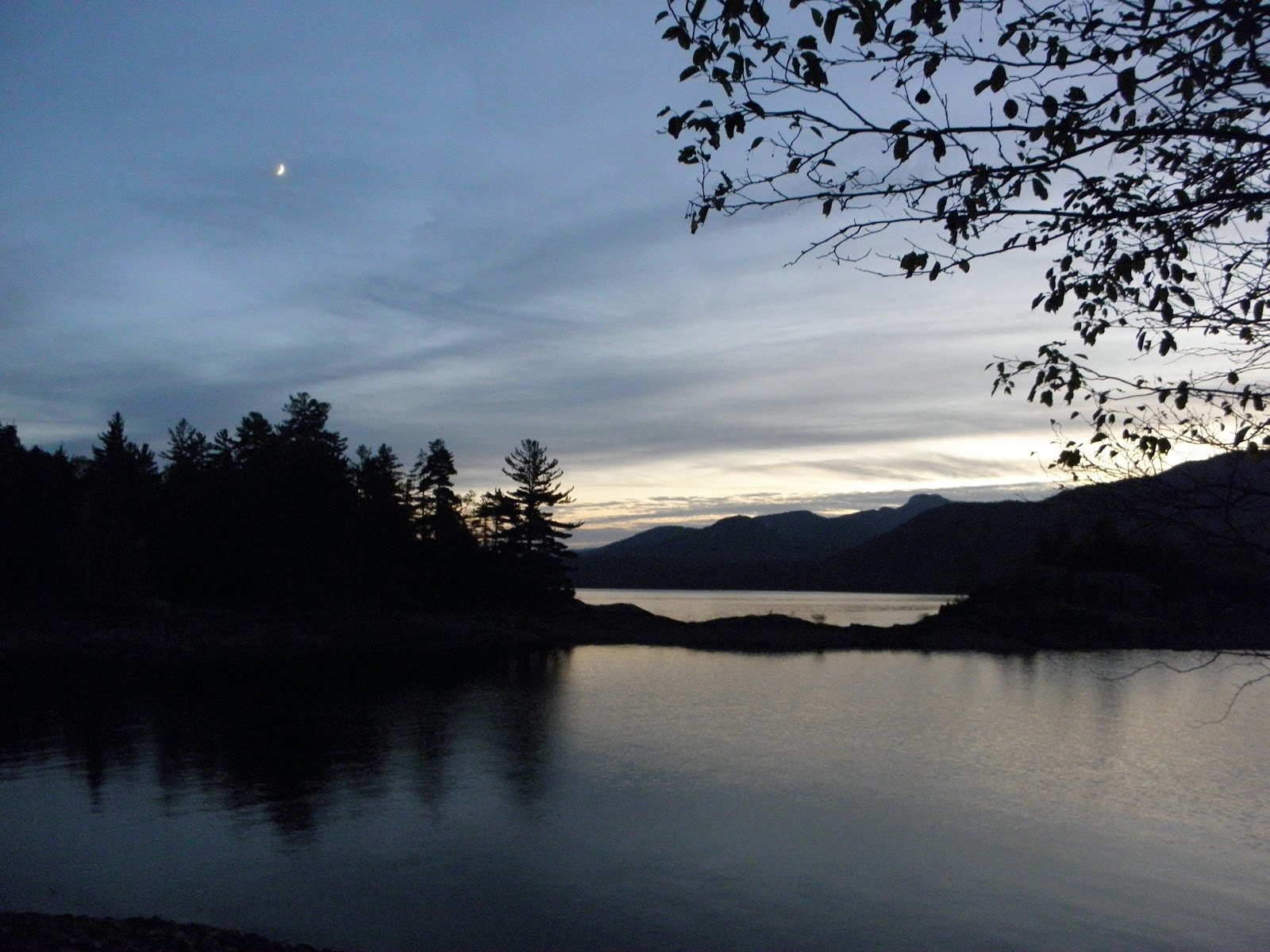
09/18/2015- We watched the sun set... and then we watched the moon set. It was certainly a sign that the days were getting shorter, and we were more north than we were used to. We decided the sky was clear and that we would take our chances with rain and not set up the tarp over our hammocks the first night. And it didn't rain.

Nathan watching the sun set.

This was our regular view from our campsite at Indian Lake, Adirondacks, NY.
First night, and you can see the moon in the sky while the sun was still setting.
Looking this direction was always breathtaking. 

startled
awoken by a leaf falling
in the dead of night.
sleep was still hanging on to my reality
and it took me some time to realize it wasn't raining
leaves falling.
i listened to them puddle all around me
until
i heard the water of the lake
lapping against the shore.
gently.
almost like a whisper on the wind.
i fell back to sleep.

09/19/2015- Norman's Cove
Indian Lake Surface Elevation - 1640 ft.
Never being there before we made a classic mistake and roped our canoes up when we first entered the cove, probably the farthest away from the trailhead that we could.

Our boats roped up at Norman's Cove before our hike. Baldface Mountain is in the distance.

Right in the center is Norman's Cove, a view from the top of Baldface Mountain, Indian Lake, Adirondacks, NY.

Hind sight. It was good to get a little warm up walking around the cove before we ascended the mountain. The trailhead sign said the summit was .8 miles. So we began going up. I actually expected it to be more difficult. I probably remember it as an easier hike, not because of the elevation gain, but because of the shortness of the hike.

Baldface Mountain
Summit Elevation - 2230 ft.
Elevation gain in .8 miles was 590 ft.

The Camping Crew: (from left to right) Michelle, Jim, Alicen (me), and Nathan.

View of Indian Lake in the Adirondack Mountains near the Baldface Mountain summit.

Nathan enjoying the summit of Baldface Mountain, Indian Lake, Adirondacks, NY.

View of Indian Lake in the Adirondack Mountains near the Baldface Mountain summit.

After we got back to camp Michelle and I went on a short exploration without the men. We walked out to the strip of land near the little island that we had been admiring the view of since we had arrived.

A little island right off the peninsula of our campsite.

The weather, the second night while we were camping is something I'll never forget.
how in the world can i describe the darkness?
the rain
the thunder
the lightning. the WIND!
the autumn winds. the autumn winds!
wind on my face
cool yet soothing.
so easy to breathe in.
like it was my life's breath.
i had to breathe it in! 

09/20/2015- The next day... Michelle and I went back with Jim and Nathan. We hiked along the lake's shore until we stumbled across the next campsite.

Jim, Nathan, and Michelle at the beginning of our campsite exploration.

Jim, Nathan, and Michelle Indian Lake, Adirondacks, NY.

It was decided at some point during our exploration that we were going to canoe over to Norman's Cove again, this time by the picnic area, and go swimming. I didn't swim. I had a beer, and just enjoyed the autumn wind and the last warmth of the fading summer sun.

A view from the Picnic Area of Norman's Cove with Baldface Mountain in the background.

09/21/2015- The morning had a heavy blanket of fog, rising from the lake, that didn't want to leave the sleepy mountains. It was an amazing sight to see. We had an amazing breakfast as we waited for the fog to burn off... and then we packed up our canoes, and paddled six miles back to the car.

Same vantage point at our campsite of the sunset photos shown earlier in this post.


Camping at Indian Lake was a wonderful experience that I feel awakened my natural instinct to go out and explore! I would certainly camp there again. A different site though, so I could see more of the area... and perhaps hike up another mountain.

For more information on Indian Lake Island Campground... Click Here!
All photos were taken by me or Nathan.